
Application Notes
Selected the Right Lens but Can't Fit It into the Equipment? A 90° Prism Solves Imaging Space Constraints
Published
In machine vision projects, lens selection must consider field of view, working distance, resolution, and installation space. A 90° right-angle prism can change the optical path direction, providing more flexible installation options for cameras and lenses without altering the main imaging parameters.
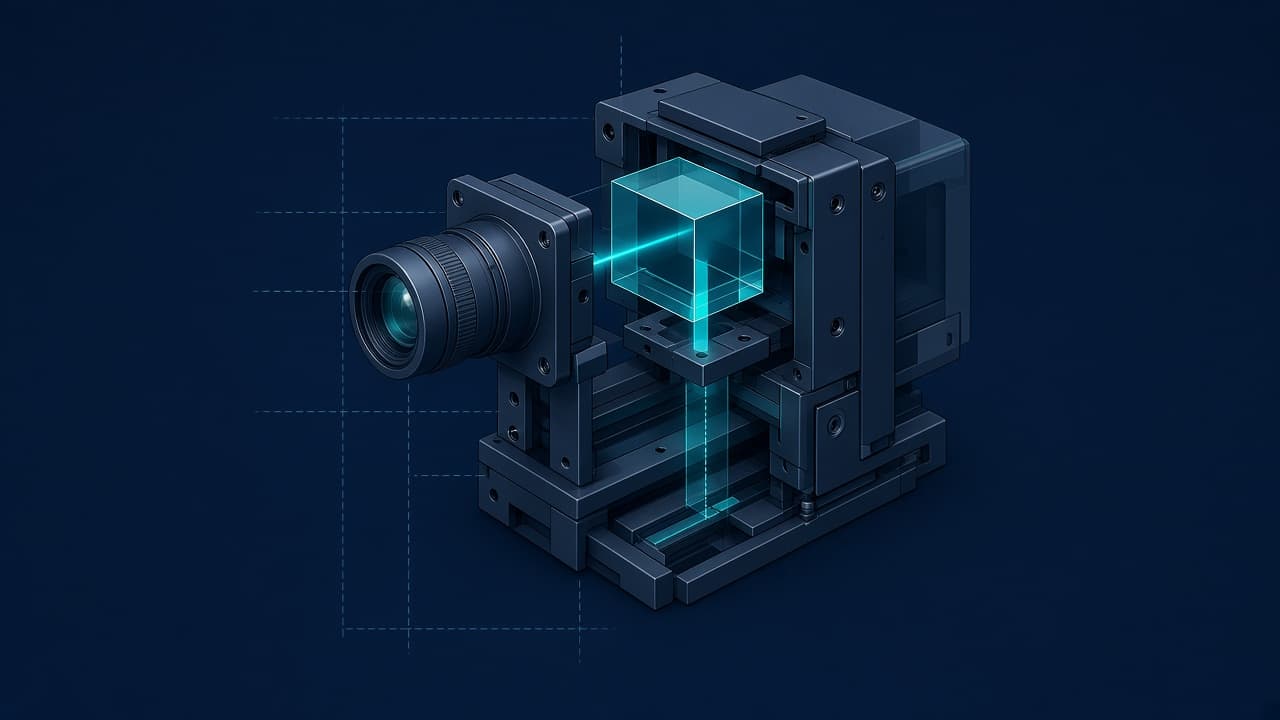
In conventional machine vision systems, the camera, lens, and object under inspection are usually aligned along the same optical axis.
For example, in applications with vertical downward inspection, the lens needs to be installed directly above the object. If the lens's working distance is 200 mm, combined with the lens length, camera size, and mounting structure, the entire vision module may require significant vertical space.
In a laboratory setting, this is usually not an issue. However, in actual equipment, the situation can be entirely different.
Above the equipment, there may already be robotic arms, motion modules, cylinders, or other mechanisms, leaving very limited space for the vision system. In such cases, even if the lens's field of view, resolution, and imaging performance meet project requirements, it may be forced to be reselected due to "not fitting in."
A common solution is to add a 90° right-angle prism between the lens and the object.
The core function of the prism is not to change the lens's working distance parameters but to alter the direction of the optical path. A section of the optical path that originally needed to be arranged vertically can be redirected 90° to propagate laterally through the prism.
This way, the camera and lens can maintain their original installation orientation, but the object can be positioned on the side, transferring the space requirement originally concentrated in the vertical direction to the horizontal direction.
For equipment with insufficient vertical space but available lateral installation space, this method can significantly enhance the flexibility of vision system layout.
Of course, adding a prism does not mean it can be directly installed and used. In practical applications, several issues still need attention, including whether the prism's effective aperture can cover the lens beam, whether it causes shading or vignetting, and the prism's installation angle and mechanical stability.
Therefore, before formally designing the equipment structure, it is best to conduct actual setup tests to confirm the field of view, imaging quality, and installation space after adding the prism.
Machine vision selection is not just about finding a "parameter-correct" lens. A truly implementable vision solution also needs to consider the match between optical performance and mechanical structure.
Sometimes, the solution is not to choose a different lens but simply to change the optical path direction.
Can't find what you're looking for?
We're here to help. Send us your requirements and our engineers will recommend the right solution.
Contact Us