アプリケーションノート
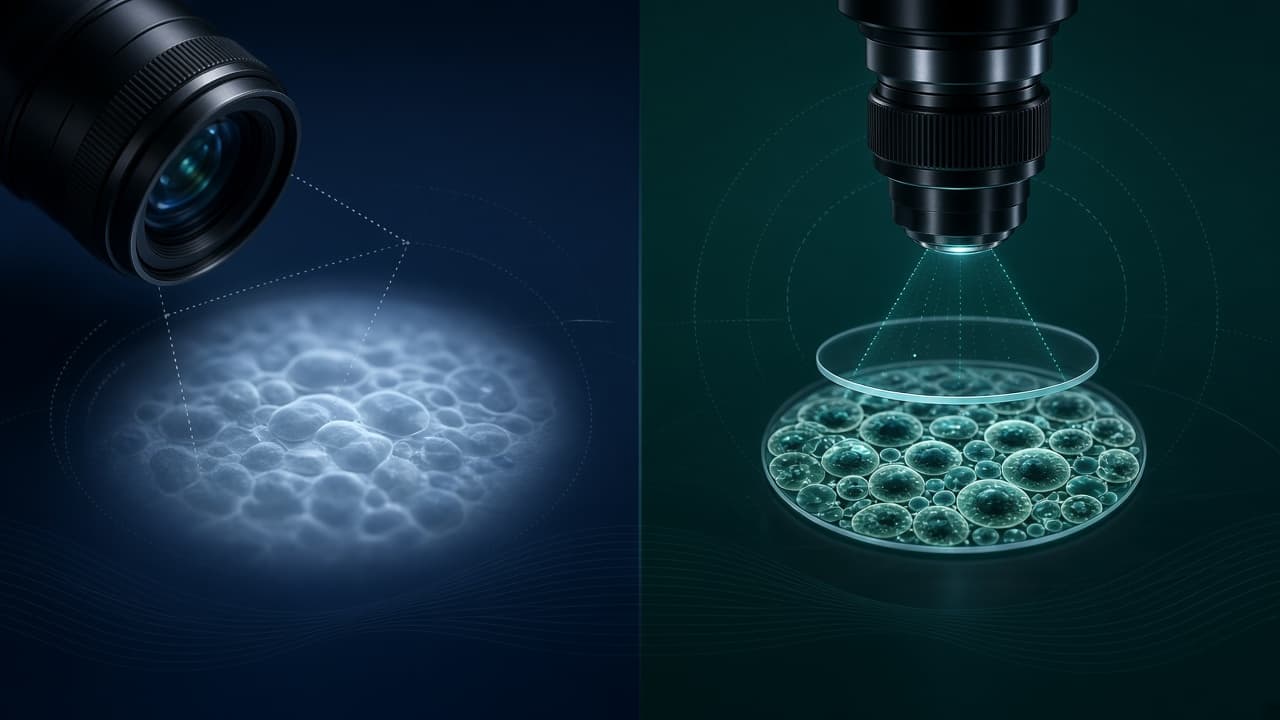
Seeing Bigger vs. Resolving More: Macro Lenses vs Microscope Objectives in IVD
公開日
Macro lenses balance wider field of view, depth of field, working distance, and throughput, while microscope objectives target cellular resolving power with small fields and shallow depth of field. Choose from target scale, tolerances, UPH, and optomechanical complexity—not magnification alone.

Abstract
In IVD and life science instruments, macro lenses and microscope objectives serve different clinical priorities. Macro balances wide FOV, DOF, working distance, and throughput; objectives target cellular resolving power with millimetric FOV and micron-level DOF. Avoid the magnification-first trap — start from target scale, consumable tolerances, UPH, and optomechanical complexity.
Key trade-offs
FOV & throughput: 0.5× macro on ~11 mm sensor ≈ 22 mm FOV (single-shot cassette/plate); 10× objective ≈ 1.1 mm FOV (tile scanning, slower UPH).
Resolution: objectives needed for RBC/platelets/bacSelection guide (short)
Macro when: features > ~50 μm; high UPH / single-shot; consumable height variation; POCT/LFA/microfluidic/tube/ELISA readers.
Objective when: 1–10 μm or sub-micron morphology; fine clinical detail primary; rigid chassis with stages/AF; hematology/urine/dPCR/NGS imagers.
Conclusion
They are not rival tiers — different biological scales. VICO can support feasibility tests with customer consumables before tooling commitment.teria-scale features; macro excels at OD/strip/microfluidic features in tens of μm–mm with flatness and low distortion.
WD & DOF: macro tolerates plastic warpage and meniscus variation; objectives need precision Z + autofocus and raise BOM.
Integration: macro is C-mount plug-and-play; infinity objectives need tube lens, filter cubes, tight alignment.